How to Use Coulombs Law and How Capacitors Work for Beginners
A capacitor is used for energy storage in circuits and can store and discharge energy quickly. It works like a battery, except it takes advantage of electrical charges to store energy rather than chemical reactions.
One of the most used components in electronics, capacitors are used commonly to smooth and filter voltage signals, manage power, and of course, store energy.
In this beginner's guide to capacitors, you will learn what capacitance and capacitors are and how to use capacitors in circuits.
What is a Capacitor?
Imagine you are an early settler of the West. You need to be able to store water so you can use it later, so you build a water tank on top of your house that collects rainwater. When you twist a nob, water comes out, and you can fill up a bucket or whatever you need.
This would be similar to a battery. It takes a long time to fill the tank, and it would take a long time to empty this tank.
Now imagine you want to pull a prank on your sibling. You build a new water tank, this time directly underneath a waterfall. You're able to fill up this tank very quickly. This new and improved tank also has a removable bottom, so all the water can leave the tank much quicker.
You go and get your sibling, trick them to play in the waterfall, and BAM! You get them with your water tank contraption.
This second tank would be like a capacitor. It can charge and discharge much faster than a battery can.
What is Capacitance?
A capacitor's ability to store electric charge is measured in capacitance. If a capacitor can store more charge, it has a higher capacitance.
Capacitance doesn't only apply exclusively to capacitors; any two conductors separated by an insulator like plastic will have capacitance.
This is why stray capacitance happens in circuits, because the individual wires are separated by their insulations or air.
Analogy for Capacitance
Imagine you have two magnets. You put one underneath a table or a desk and the other on top, and they both stick together.
Even though they aren't touching, they still somehow magically are be attracted to each other.
This is similar to capacitance, although capacitance deals with electric fields, not magnetic fields. The electric charges, although they aren't touching, are attracted to each other, causing them to stay in place.
What is Capacitance Mathematically?
Capacitance is measured in farads (), named after Michael Faraday for his formulation of Faraday's Law.
In equations, capacitance is represented with a . Mathematically, capacitance is
Where
-
is capacitance in farads,
-
is electrical charge in coulombs, and
-
is the voltage in volts.
Let's try out a practice problem quick.
A capacitor of receives a signal. How much charge is stored once the capacitor is fully charged?
How Capacitors Work in a Circuit
Capacitor Charging
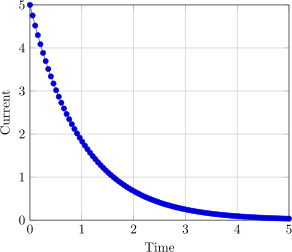
As a capacitor is getting charged in a DC circuit, it allows current to flow in the circuit. As it charges however, the current will decrease until the capacitor is fully charged. That's when the current stops flowing.
Current stops flowing because once the capacitor's voltage stops changing, there is no reason for charge to keep moving.
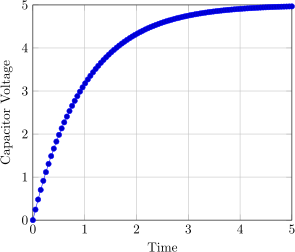
Voltage in a capacitor behaves differently. As the capacitor charges, the voltage will increase until it is equal with the power source's voltage.
Capacitor Discharging
When a capacitor discharges, the stored electric charge flows out of the capacitor and into the circuit. As this happens, the voltage across the capacitor decreases over time.
One detail that often confuses beginners is the direction of current during discharge.
When a capacitor discharges, current flows in the opposite direction compared to when it was charging. This happens because charge always moves from higher voltage to lower voltage. As the capacitor's voltage drops, current continues to flow until the stored charge is depleted.
Nonpolar Vs. Polar Capacitors
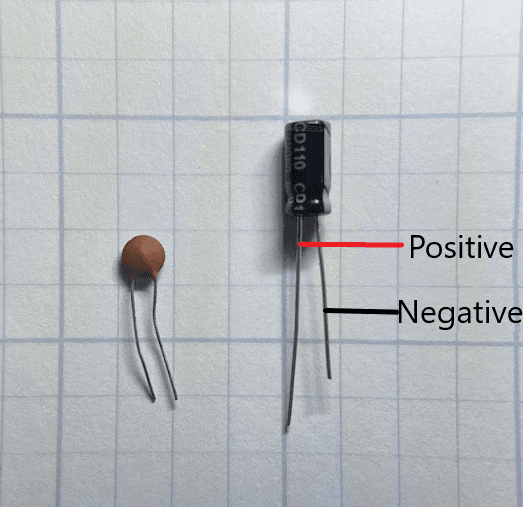
There are two types of capacitors: nonpolar (left) and polar (right).
Nonpolar capacitors don't have a positive or negative side. They can be connected in any orientation in a circuit.
Polar capacitors however must be connected with their positive side (longer lead) into the positive terminal and the negative side (shorter lead) in the negative terminal.
How to Use Capacitors on Breadboards
This video demonstrates how to connect a capacitor on a breadboard. Notice how the LED slowly dims, showing that the capacitor is discharging into the LED.
Notice that this capacitor type is polarized, so the positive lead must be connected to the positive voltage source.
Conclusion
Capacitors are useful components in circuits that teach beginners how voltage, current, and capacitance all are related to one another.
These components, whether polar or nonpolar, are an essential tool when building circuits from beginner levels to pro.
People Also Ask
About the Author
This article was written by Boden Bensema, an electronics hobbyist focused on teaching beginner-friendly circuit design, breadboarding, and electronics fundamentals.
About page