Why Electronic Circuits Work the Way They Do
Electronic circuits are an art. There is always something new to learn, and that may seem pretty daunting for a beginner trying to learn about circuits. That is exactly who this article is for: beginners who are overwhelmed by the endless places to start learning about circuits.
This article provides a firm foundation on where to start learning about circuits as a beginner. Everything is explained thoroughly and with easy to understand terminology.
A Background on Electricity
Before diving right into the fundamental laws of electronics, it's important to understand the physical meanings of all the electrical quantities and units used in these laws. Voltage, current, resistance, and power describe how electricity behaves inside a circuit, and each plays a distinct role in determining how a circuit operates.
Understanding these basic concepts first makes learning circuit laws far more intuitive and less overwhelming for beginners.
Voltage
Voltage (measured in volts, ) represents the electrical potential difference between two points in a circuit. Don't worry if that sounds overwhelming to you. A common way to visualize and understand voltage is by comparing it to water pressure in a pipe.
If one section of a pipe has higher pressure than another, water naturally flows toward the lower-pressure area to balance the pipe's pressure. In a similar way, voltage exists when there is a difference in electrical potential between two points, like the positive and negative terminals of a battery.
In a circuit, voltage does not "flow" on its own. Instead, it provides the driving force that pushes electric charge through a conductor when a complete path is available. Mathematically, voltage describes the potential energy difference that causes current to flow.
Example
A battery connected to a circuit means each coulomb of charge has 9 joules of energy available to push through the circuit.
Current
Electric current (measured in amperes, ) describes the rate at which electric charge flows through a conductor.
Using the water-in-a-pipe analogy, current is similar to the flow rate of water, not the speed of individual water molecules. This difference is important for beginners to understand. Current measures how much charge (or water) passes a point per second, not how fast individual charges move.
Current only flows when a circuit is closed and a voltage difference is present. You will see why when you look at Ohm's Law.
Example
If 2 amperes flow through a wire, that means 2 coulombs of charge pass a point in that wire every second.
Resistance
Electrical resistance (measured in ohms, ) represents how much a material opposes the flow of current.
In the pipe analogy, resistance is similar to the friction between the water and the pipe's walls. In electrical circuits, the more area an electric charge has to flow through, the larger the resistance will be, similar to how the longer the pipe, more friction will be slowing down the water.
Resistance plays a crucial role in controlling current and managing energy loss in the form of heat.
Example
If you have a battery connected to a resistor with a resistance of , using Ohm's Law we can calculate the current this circuit will draw:
The resistor provides resistance to a circuit to limit current to a safe level.
Power (Watts)
Electrical power (measured in watts, ) describes the rate at which electrical energy is transferred or converted in a circuit.
Power tells us how quickly a device uses energy or converts it into other forms, such as light, heat, or motion. Components like light bulbs, heaters, and motors are often rated by their power consumption, making watts one of the most practical units in real-world electronics.
Example
If we have a battery giving of current in a circuit, the power used will be .
Fundamental Laws of Circuits
These laws give you a deeper understanding on how every electrical concept is interconnected. These laws are very important to learn and understand conceptually. When I was a beginner, I just wanted to dive right in to making circuits without all the technical math concepts.
These articles have examples you can try in real life that give you a fundamental understanding of circuits and their underlying physics.
Watt's Law and Joule's Law
These laws explain how electricity is used and why electrical circuits can heat up when current is flowing through them. These laws are important to learn as a beginner because they help you figure out how much electricity a circuit will "consume" and where energy loss (typically heat) will occur.
Whenever you want to determine if it's safe to use a certain component in a circuit, these laws are key to your success.
Watt's Law explains the relationship between voltage, current, and power, making this law essential for understanding how circuits consume energy. Closely related is Joule's Law, which connects current, resistance, and power. Joule's Law explains why wires and components heat up during operation.
To see these laws in action and try them out yourself, check out the full article guides:
Faraday's Law and Lenz's Law
Faraday's Law and Lenz's Law are closely related. Faraday's Law explains how a magnet moving close to a conductor creates electricity (specifically a voltage known as an EMF), and Lenz's Law determines which way this induced EMF will flow in a circuit. These laws are important for beginners because it teaches about induction, an important concept that you use daily. Whether your source of power is through natural resources like coal or nuclear energy, it likely uses Faraday's Law and Lenz's Law to generate electricity.
To try out these laws for yourself, try reading these articles:
Ohm's Law
Ohm's Law connects resistance, voltage, and current. It explains the why behind how short circuits can damage an electronic circuit. Ohm's Law is important to learn because it connects three very important electrical concepts that are essential to understand as a beginner.
You can learn more about Ohm's Law here through this in-depth guide:
Coulomb's Law
Coulomb's Law deals with the electrostatic force between two charged particles based on their distance from each other.
This may seem like a lot of big words, but I assure you, once you read more about Coulomb's Law it will all make sense.
Through learning about Coulomb's Law and coulombs, you get to see how capacitors and farads work.
Putting it All Together
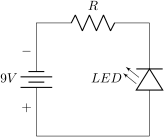
The LED is the triangle with a line on the tip and the resistor is the squiggle labeled
If the LED can only take of current and the battery supplies , what is the minimum value the resistor can have? How much power is used? How much thermal energy will the resistor dissipate in seconds?
Conclusion
After reading this article, I hope you feel less overwhelmed by electricity and magnetism. Learning about these concepts and understanding more about your physical world can help you better understand how your world works.
If you feel like you don't fully understand these concepts yet, don't get discouraged. These aren't easy topics. If you ever get stuck on a problem, you can always use the interactive tools to figure out the solution to a problem regarding one of these laws. If you want to get started with building circuits, check out my article on circuit tools and components for beginners.
People Also Ask
About the Author
This article was written by Boden Bensema, an electronics hobbyist focused on teaching beginner-friendly circuit design, breadboarding, and electronics fundamentals.
About page