Faraday's Law Explanation, Equation and Real World Examples for Beginners
Faraday's law of electromagnetic induction states that a changing magnetic field produces an electric voltage in a conductor, such as a copper wire. This phenomenon is known as electromagnetic induction and is the fundamental principle behind generators, transformers, and electric motors.
Michael Faraday first proposed these laws in 1831 from observations and results from his experiments. Faraday had a hypothesis that magnets could induce, or create, electricity in wires. After 10 years of on and off work, he finally created electricity from two coils of wire and a magnet.
Contrary to what many perceive, it's not the magnetic field itself that creates electricity, but a change in magnetic flux. Don't worry if this sounds complex, this article explains magnetic flux in depth later on.
Because of Faraday's discovery, generators, electromagnets, speakers, and many more everyday items were made possible.
What Faraday's Law Means Physically
In order to really understand Faraday's Law, it's a good idea to know what this law physically means in simple and easy to understand terms.
What is Magnetic Flux?
Magnetic flux is the measurement of the magnetic field passing through an area. This term is used a bit when explaining Faraday's law, and is useful to know.
How Does a Changing Magnetic Flux Create Electricity?
When a conductor is inside a changing magnetic field, electric charges inside the conductor experience a force (called the Lorentz force) that causes them to move.
Because electricity (or more specifically, electric current) is the movement of electrons, when the magnetic flux changes in a conductor, electricity is created.
How Inductance Comes from Faraday's Law
Faraday's Law doesn't just apply when a wire moves through a magnetic field or when a magnet passes by a conductor. It also applies when the conductor itself creates the changing magnetic field. This is where inductance comes from.
Inductance (measured in henries, ) describes how strongly a conductor or coil resists changes in electric current due to the magnetic field it creates around itself.
When current flows through a wire or coil, it produces a magnetic field. If that current changes, the magnetic field also changes. According to Faraday's Law, a changing magnetic flux induces a voltage. In this case, the induced voltage appears in the same conductor that created the magnetic field.
This induced voltage always acts in a direction that opposes the change in current. This effect is described by Lenz's Law and is why an inductor resists changes in current.
A useful way to think about this is with inertia. Just as a heavy object resists changes in motion, an inductor resists changes in current. The faster the current tries to change, the stronger the opposing voltage becomes.
Inductance is strongest in coils of wire because multiple loops increase magnetic flux. This is why inductors are typically made from tightly wound coils and are commonly found in transformers, motors, speakers, and power supplies.
Because inductance depends on changing current:
- In a steady DC circuit, an ideal inductor eventually behaves like a short circuit
- In AC circuits, where current is constantly changing, inductance plays a major role in limiting and shaping current flow
- Inductance is not a separate idea from Faraday's Law—it is Faraday's Law applied to real circuits.
Is Faraday's Law the Secret to Free Energy?
No, no new energy is being created. Energy is only being transformed from mechanical (movement) energy to electrical energy.
Faraday's Equation
The faster the magnetic field (or environment) around a conductor changes, and the more loops of wire there are, the larger the voltage produced.
This may look like a big and complicated equation with weird symbols, but when broken down, it's not too bad.
Breakdown of Variables
- (Epsilon) is the electromotive force (or voltage) measured in Volts ().
- is the number of turns in the wire or coil the magnetic field is acting on.
- (Delta Phi) is the change in magnetic flux, measured in Webers ().
- (Delta t) is the change in time, measured in seconds ().
The negative sign in Faraday's equation comes from Lenz's Law, which describes the direction of the induced voltage.
When does Faraday's Law apply?
This equation applies whenever a conductor moves within a magnetic flux or a magnetic flux weakens/gets stronger (both affect ) over time ().
How to Calculate Magnetic Flux
- is the magnetic flux, measured in Webers ().
- is a vector that represents the strength and direction of the magnetic field, measured in Teslas ().
- is a vector whose magnitude () is the area () of the conductor, and whose direction is always perpendicular to the surface.
- is the angle between and .
Notice how in the rightmost equation, if is , the magnetic field is at its strongest with a constant and . If it's at , or is perpendicular to , the magnetic flux will be 0. Even though the and don't have the vector line, the equation can still be negative at .
How to Determine the Magnetic Flux's Direction
Because is a vector, you will need to know how to determine if it is positive or negative. For open loops (shown below), you get to choose. Once a direction for is chosen, it must be used consistently throughout the problem.
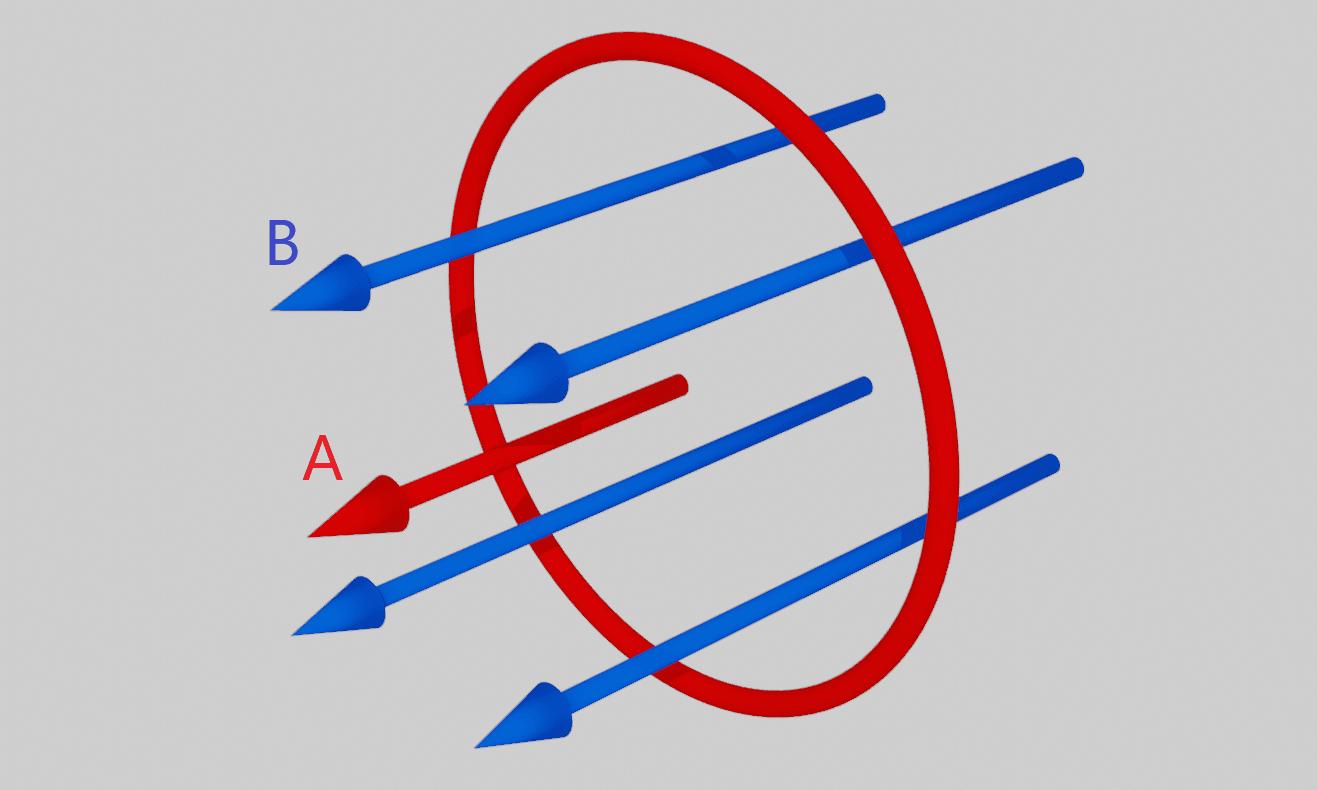
Because we declared as positive when going to the left, the magnetic field, going to the left is positive as well. This is a simplified diagram, but it should get you on the right track.
Additionally, in this diagram, is , because and are parallel. This is the maximum flux, as equals 1.
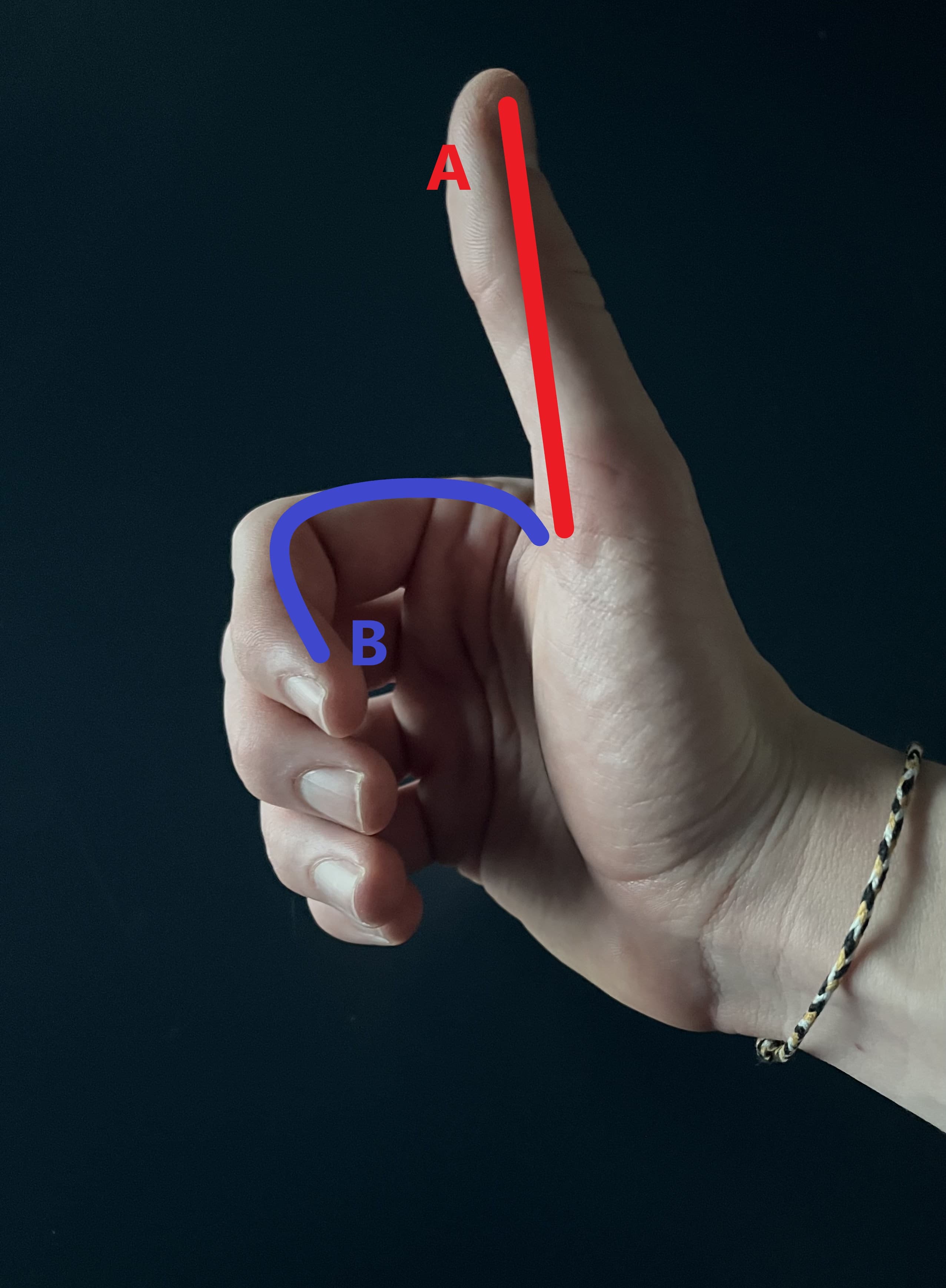
A good literal rule of thumb is to put your right hand in a thumbs-up position. would be the direction of your thumb, and is the direction your of other fingers away from your hand.
How to Solve Faraday's Law Problems
Now that you have a conceptual understanding of Faraday's law, let's take a look at some practice problems.
Practice Problem 1: Beginner Level
A coil with 50 turns experiences a change in magnetic flux from to in . What is the induced voltage?
Practice Problem 2: Intuitive Understanding
A loop of wire sits in a steady magnetic field. The magnetic field is strong but does not change. Is any voltage induced in the loop of wire?
Practice Problem 3: Harder
A conductor of surface area is subjected to a strong magnetic field of strength at an angle of . The magnetic field intensifies to in seconds. If the conductor has turns, what voltage is induced?
If you ever get stuck on a problem with Faraday's Law, check my interactive Faraday's Law calculator
How Faraday's Law is Used in Real Life
With just a simple motor used in toys, you can power an LED. The following video demonstrates this concept:
What's happening here is when the motor spins, the magnets connected to its shaft rotate and pass through copper wires. This induces an electric current, powering the LED. This is a very broad explanation on how motors work, but to learn more, check out this article on how motors use Faraday's law.
The generators used in power plants, whether through nuclear or coal, also works in this way. Without Faraday's Law, we would have to rely on electrochemical batteries for our power.
Conclusion
Faraday's law explains how changing magnetic fields produce electric voltage, forming the foundation of modern electrical technology. From power plant generators to electric motors and speakers, this law allow mechanical motion to be transferred into electricity.
By understanding magnetic flux, what the rate of change of magnetic flux means, and how the conductor affects the voltage created, you are on your way to becoming an expert on circuits and its fundamental laws.
If you want to explore other fundamental laws, check out this article on Ohm's law which teaches you how to calculate other things from how much voltage Faraday's law induces, such as current. To learn about how electrostatic forces work, check out my article on Coulomb's Law.
Faraday's law is not just a physics equation, it's one of the core principles that makes modern life possible. To learn more about other core principles of modern life such as Ohm's Law, Lenz's Law, and Joule's Law, see my article on electronics fundamentals for beginners.
People Also Ask
About the Author
This article was written by Boden Bensema, an electronics hobbyist focused on teaching beginner-friendly circuit design, breadboarding, and electronics fundamentals.
About page