How to Use Resistors on Breadboards and Calculate Resistance
Resistors are one of the most important electrical components to learn about. They teach you how to protect other components, change voltage, and can help you understand how parallel and series circuits work.
In this tutorial, you will learn how to use resistors on a breadboard, what resistors are used for, and how to calculate their resistance in series and parallel circuits.
What is Resistance?
Resistance is similar to friction.
In an electrical circuit, resistance is what slows down the flow of electric current. Resistors in circuits are components designed to control this in a predictable way.
You can think of a resistor like an ice rink where the ice is choppy and rough. The skater can still move, but not as easily. In the same way, electricity can still flow through a resistor, but resistance limits how much current flows.
Resistance exists in all conductors, just like how friction exists between all surfaces. Even if the ice looks perfectly smooth, there is still some friction. Even very good conductors such as copper wire still have resistance.
Conductors are any material (like copper and iron) that conducts electricity.
The difference is that resistors are intentionally designed to have resistance, while wires are designed to have as little resistance as possible.
What is a Resistor Used For?
Resistors are used for a variety of things within a circuit. They can be used to limit current, divide voltage, bias other components, shape signals, and pull pins up or down.
For the purposes of this article, we will be exploring the first 2 listed above.
Using Resistors to Limit Current
Limiting current is important when using things like LEDs and transistors. These components can't control how much current is flowing through them.
If no resistor is connected to these components, they can try to draw too much current and get burnt out, like a child eating candy; if left unchecked, they will eat as much as they can despite it being bad for them!
Luckily, there's a solution: resistors. A resistor solves this problem by restricting the flow of current. We use resistors to limit current by connecting them to the existing circuit in series with the component, so the resistor "absorbs" part of the voltage and keeps the current at a safe level.
Finding the right resistor value can be done through Ohm's Law.
Using Resistors to Divide Voltage
Sometimes a circuit needs a lower voltage than the power supply provides. For example, a logic gate might need a input but the power source supplies or more.
We can create this voltage difference using resistors.
A voltage divider uses two or more resistors connected in series to split the supply voltage into smaller parts. Because the same current flows through all series components, voltage is the shared between the resistors based on their resistance values. The bigger the resistor, the bigger the voltage drop will be.
A voltage divider doesn't create new power, it just divides an existing voltage into smaller levels.
Resistance in Series and Parallel Circuits
The resistance caused by a resistor is different depending on how you wire the resistor in your circuit.
Luckily, there's two straight-forward equations to help us figure out how much resistance a resistor will have in a circuit.
Resistance in Series
When you connect resistors in series in a circuit, the total resistance () equals the resistance of all the resistors added together.
In the example below, the resistor is the little squiggly line. That is what the symbol for resistors is in circuit schematics.
Let's try this example problem:
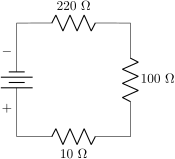
What is the total resistance?
Resistance in Parallel
When you connect resistors in parallel, you add the reciprocal of all the resistors and then take the reciprocal of that answer.
The total resistance will always be less than the smallest individual resistor because adding parallel paths allows more current to flow.
Let's try another example:
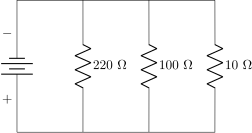
What is the total resistance?
Resistors in Circuits
Let's dive in to how to wire resistors in series and parallel.
Resistor Values
Resistors come in many different values, and most through-hole resistors show their value using colored bands instead of numbers. Each color represents a digit or multiplier, and when you read the bands from left to right, they tell you the resistance in ohms.
If you're just getting started, don't worry about memorizing the colors right away. A color code calculator makes this much easier and faster while you're learning. You can use an online tool like this one to decode resistor values quickly: Resistor Color Code Calculator
Over time, you'll start recognizing common values (like , , or ) just by looking at the bands, which makes building and debugging circuits much easier.
How to Wire Resistors in Series With an LED
In this video, we start by building a circuit with a resistor to light an LED. With this low resistance, more current can flow, so the LED appears fairly bright.
When we add another resistor in series, the LED becomes slightly dimmer. This is because series resistors add together, giving a total resistance of , which limits the current more.
Conclusion
Resistors are a good starting point for beginners in electronics. They provide a doorway into understanding parallel and series circuits, resistance, Ohm's Law, current, and voltage.
If you want to dive into circuits or this article overwhelms you, see my article on beginner's tools and components.
People Also Ask
About the Author
This article was written by Boden Bensema, an electronics hobbyist focused on teaching beginner-friendly circuit design, breadboarding, and electronics fundamentals.
About page