How to Use LEDs: Series & Parallel Diagrams with Examples
Light emitting diodes (LEDs) are one of the first electronic components most beginners work with when learning electronics. They're inexpensive, simple to use, and give immediate visual feedback when a circuit is working.
In this beginner-friendly guide, you'll learn how to wire an LED on a breadboard correctly and safely, including single LEDs, multiple LEDs, LEDs in series, LEDs in parallel, and why resistors are required. By the end, you'll be able to build working LED circuits with confidence without guessing or damaging components.
LED Pinout Diagram
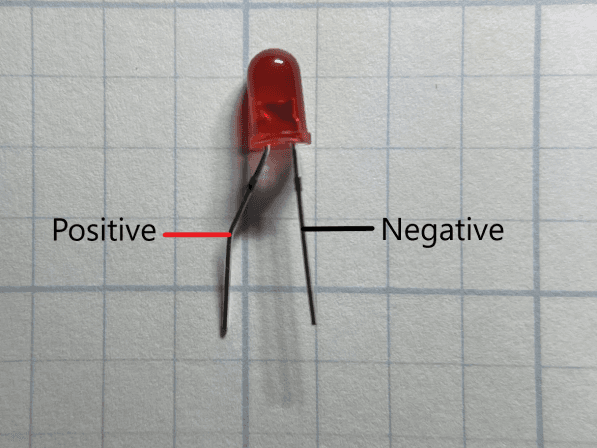
Pinout in electrical circuits is a reference guide that tells you the function of all the pins on an electrical component.
LEDs have two leads: a positive lead and a negative lead. The positive lead is called the anode, and the negative lead is called the cathode.
On most standard LEDs, the positive lead is longer than the negative lead. Wiring an LED backwards usually won't damage it, but it will prevent the circuit from working.
What does an LED look like in a schematic?

And LED looks like a triangle with a line on the tip and arrows on the top, showing it gives off light. In a schematic, the positive side of the LED is the side without the line and the side with the line is the negative lead.
How to Wire a Single LED on a Breadboard
This section shows how to wire a basic LED circuit on a breadboard.
A breadboard allows you to build circuits without soldering by internally connecting certain holes together. In the center area, holes are connected in rows of five. Any components placed in the same row are electrically connected. The long columns on the sides are power rails, typically used for power and ground.
For an LED to work correctly, its two legs must be placed in different rows. If both legs are placed in the same row, the LED will not turn on because both leads are electrically connected.
Make sure the LED is oriented with the longer (positive) lead connected to the resistor, and the shorter (negative) lead connected to ground (usually a black wire).
Why LEDs Need Resistors
A common beginner question is: "Why is that resistor there?" or even "What does a resistor do?"
Resistors are one of the most common components in electronics. Their job is to limit current. LEDs cannot limit current on their own. Without a resistor, an LED will try to draw as much current as possible, which can quickly burn it out.
In simple terms, resistors protect LEDs. If you're new to the concept of current, see this beginner guide to electric current.
It does not matter whether the resistor is placed on the positive or negative side of the LED. What matters is that every LED has current limiting.
LEDs in Series
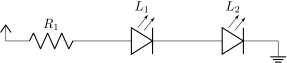
When LEDs are wired in series, they all share the same current, but their forward voltages add together. This behavior is the same as other series circuit configurations.
Because the current is the same through each LED, LEDs wired in series tend to have consistent brightness. This is one reason series wiring is often preferred.
Another advantage of series wiring is that you only need one resistor for the entire chain. The tradeoff is that you must choose a resistor value that accounts for the total forward voltage of all LEDs.
How to Wire LEDs in Series on a Breadboard
Follow these steps to wire two LEDs in series:
- Connect one side of a resistor to the ground rail and place the other side into an empty row.
- Insert the negative (short) lead of the first LED into the same row as the resistor.
- Place the positive (long) lead of the first LED into a new row.
- In that same row, insert the negative lead of the second LED.
- Connect the positive lead of the second LED to the positive power rail.
Once connected, you're ready to power the circuit.
LED Series Video
If you learn better by watching, this short clip shows how to wire two LEDs in series on a breadboard:
Once powered on, both LEDs should turn on at the same time and appear equally bright.
Recommended Power Supply for LED Projects
If you're looking for a reliable and beginner-friendly bench power supply, I recommend the adjustable unit I use from Sky Toppower. It makes dialing in voltage and current simple when working with LEDs.
LEDs in Parallel
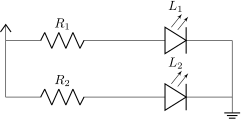
Unlike LEDs wired in series, LEDs connected in parallel must each have their own resistor.
In a parallel LED circuit, the voltage does not add together. This means the required supply voltage is lower than a series configuration. However, the total current required increases. As a result, the total power consumption is often similar to LEDs wired in series.
How to Wire LEDs in Parallel on a Breadboard
Follow these steps to wire two LEDs in parallel:
- Connect two resistors to the negative power rail and place their other ends into two separate rows.
- Insert the negative leads of each LED into the rows connected to the resistors.
- Place the positive leads of each LED into two separate rows.
- Connect each of those rows to the positive power rail.
You have now wired two LEDs in parallel.
LED Parallel Video
Once powered on, both LEDs should turn on and emit light.
3 Most Common Mistakes Beginners Make When Wiring LEDs
1. Reversing the Positive and Negative Leads
One of the most common mistakes is wiring the LED backwards. When this happens, the LED will not light up. This usually does not damage the LED.
To fix this, make sure the longer lead is connected to the positive supply and the shorter lead is connected to ground.
2. Forgetting to Add a Resistor
Forgetting the resistor may not cause immediate failure, but it is damaging the circuit behind the scenes.
Without current limiting, the LED will attempt to draw excessive current. This can overheat and destroy the LED, and in some cases damage the power supply as well.
3. Using Only One Resistor for LEDs in Parallel
When LEDs are wired in parallel, using a single resistor is a common beginner mistake. Because LEDs do not share current evenly, one LED can end up drawing more current than the others.
This can cause uneven brightness, overheating, and premature LED failure. Each LED in a parallel circuit needs its own resistor to ensure safe and consistent operation.
Conclusion
Learning how to wire LEDs correctly is an essential first step in electronics. Understanding LED polarity, current limiting, and the difference between series and parallel circuits will help you avoid common mistakes and build reliable projects.
Once you're comfortable wiring LEDs, these same concepts apply to many other electronic components. Mastering the basics here will make everything else in electronics easier to understand.
People Also Ask
About the Author
This article was written by Boden Bensema, an electronics hobbyist focused on teaching beginner-friendly circuit design, breadboarding, and electronics fundamentals.
About page