A Beginners Guide to Series and Parallel Circuits
The common beginner circuit with a battery, an LED, and a resistor is a good starting point for beginners, but it's not a good place to stay.
Learning about two of the most common circuit patterns, series and parallel, is a good next step for beginners on their journey in electronics.
What is a Series Circuit?

A series circuit is made of components connected in a single line, forming just one path for electricity to flow. Because there's only one path, series circuits directly affect voltage.
Think of electricity like water flowing through a pipe. In a straight pipe, the water flows smoothly from start to finish. If you add another section to that pipe (like a valve or a narrow segment) the water has to pass through it too. Each added section slows things down and shares the pressure. In the same way, in a series connection, the voltage is shared across all components, and the current stays the same throughout the circuit.
This is why when you connect batteries in series, their voltages add up. When you connect resistors in series, their resistances add up.
What is a Parallel Circuit?
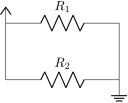
Parallel circuits directly affect current. A parallel circuit is like a ladder, where the components are the rungs on the ladder and the sides of the ladder are the positive and negative terminals of a power supply.
Thinking back to water in a pipe, a parallel circuit would be like having a main pipe (the power supply's terminals) branch off into other pipes that eventually reconnect to the main pipe.
Unlike series circuits, parallel circuits cause current to add up when you connect power sources in parallel. Other components like resistors and capacitors behave differently, which we will be covering later.
Series vs. Parallel Circuits Compared
| Aspect | Series Connection | Parallel Connection |
|---|---|---|
| Voltage | Divides across components (total voltage is shared) | Same across all branches |
| Current | Same through all components | Divides among branches (total current adds) |
| Resistance | Adds directly: | Adds reciprocally: |
| Capacitance | Adds reciprocally: | Adds directly: |
| Inductance | Adds directly: | Adds reciprocally (ideal, uncoupled): |
Before applying formulas or solving circuit problems, it's important to understand how series and parallel connections behave physically. The way components are connected determines how voltage, current, and different electrical properties are shared throughout a circuit.
The table above summarizes the key differences, but each row deserves a bit more explanation to fully make sense of why these rules work.
Voltage in Series and Parallel Circuits
In a series circuit, the same current flows through every component. Because energy is used by each component along the path, the total voltage supplied by the source is divided among them. Each component receives a portion of the total voltage, and all of those voltage drops add up to the source voltage.
In a parallel circuit, each branch is connected directly across the voltage source. This means every branch experiences the same voltage, regardless of how many components are added. Voltage does not split in parallel circuits.
Current in Series and Parallel Circuits
In a series circuit, there is only one path for electric charge to move. As a result, the same current flows through every component. If any part of the circuit is broken, current stops everywhere.
In a parallel circuit, current has multiple paths to follow. The total current supplied by the source is divided among the branches based on their resistance. The more branches that are added, the more total current the source must provide.
Resistance in Series and Parallel Circuits
When resistors are connected in series, their resistances simply add together. Each resistor makes it harder for current to flow, increasing the total opposition to current.
In parallel, adding more resistors actually decreases the total resistance. This is because each new branch provides an additional path for current to flow. For this reason, total resistance in parallel circuits is found using reciprocal addition.
Capacitance in Series and Parallel Circuits
Capacitors behave in the opposite way resistors do.
In a series connection, capacitors store charge on the same amount of charge passing through each one, causing the total capacitance to decrease. This is why capacitance adds reciprocally in series.
In a parallel connection, capacitors all experience the same voltage and can store charge independently. Their capacitances add directly, increasing the total ability of the circuit to store electric charge.
Inductance in Series and Parallel Circuits
Inductors behave similarly to resistors when combined.
In a series circuit, inductances add directly. Each inductor contributes to the total opposition to changes in current.
In a parallel circuit, inductance adds reciprocally, assuming the inductors are ideal and not magnetically coupled. Multiple parallel paths reduce the overall opposition to changing current, just like parallel resistors reduce total resistance.
Components in Series and Parallel
To learn about how to use specific components in series or parallel, check out the links below.
Conclusion
Series and Parallel circuits are important to learn as a beginner. When you fully understand how series and parallel circuits work and what their differences are, you are on your way to becoming a master at circuitry. If you want to start learning about how you can start your journey, check out my article on the tools and components every beginner needs.
People Also Ask
About the Author
This article was written by Boden Bensema, an electronics hobbyist focused on teaching beginner-friendly circuit design, breadboarding, and electronics fundamentals.
About page