Lenz's Law Explained for Beginners
Lenz's Law (named after Heinrich Lenz who first derived this law in 1834) states that the direction of an induced voltage (EMF) through Faraday's Law always drives current in a direction that opposes the change in magnetic flux that caused the EMF.
This opposing behavior is not accidental. Lenz's Law is a direct consequence of the conservation of energy, and it explains why devices like electric generators, transformers, motors, and magnetic braking systems work the way they do. Without Lenz's Law, it would be possible to build perpetual motion machines; something that violates fundamental physical principles.
Conservation of Energy and Lenz's Law
Lenz's Law boiled down simply is explaining that energy cannot be created from nothing. If a changing magnetic field could induce a current that reinforced the change instead of opposing it, the system or circuit would be creating energy out of thin air.
Because the magnet is pushed against a resisting force (often called an eddy current), work must be done. That mechanical work is converted into electrical energy in the circuit and thermal energy due to resistance.
If the induced current instead assisted the magnet's motion, the magnet would accelerate on its own while generating electrical energy at the same time. This would create energy from nothing, violating conservation of energy.
Physical Example of Lenz's Law
Imagine pushing a magnet toward a coil of copper wire in a circuit. As the magnet gets closer, the magnetic flux through the wire increases. According to Faraday's Law, this changing flux induces a voltage and a current in the loop that follows the right hand rule.
If you make your right hand into a thumbs up position, you can determine which way the current () and the magnetic field () will travel. As shown below, the current will go in the direction of your thumb and the magnetic field will go towards the tips of your fingers.
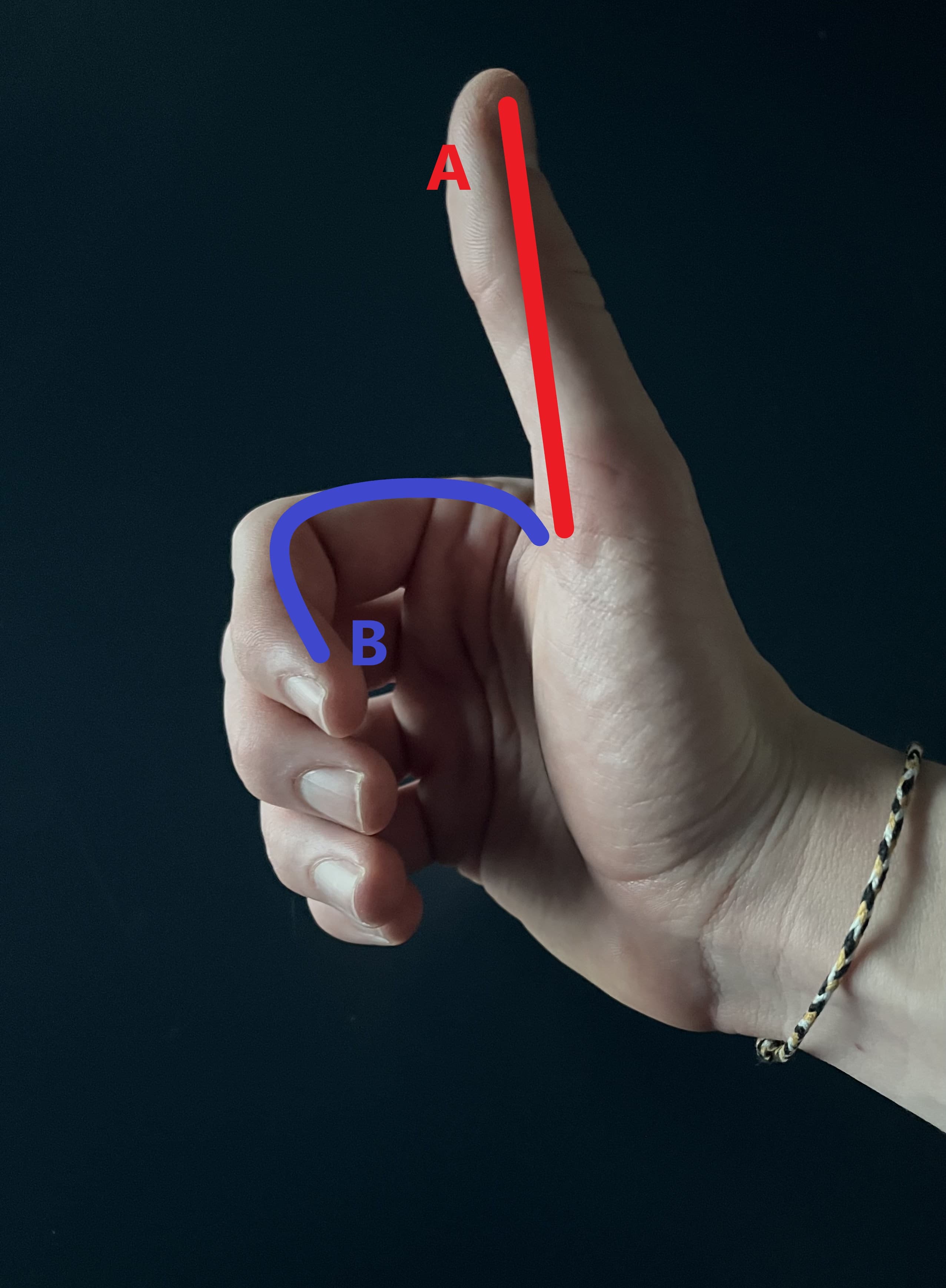
Lenz's Law tells us that the magnetic field produced by the current will always go in the opposite direction of the magnet.
This opposition creates a resistive force that makes the magnet harder to push.
This is why Lenz's Law debunks all perpetual motion machines. If you try to generate electrical energy through induction, the mechanical energy has to be greater than the electrical energy produced. In fact, in every circuit, energy is actually lost due to resistance through Joule's Law.
What Lenz's Law Means Mathematically
Lenz's Law lies inside of Faraday's Law. It is the negative sign in front of the :
- (Epsilon) is the electromotive force (or voltage) measured in Volts ().
- is the number of turns in the wire or coil the magnetic field is acting on.
- (Delta Phi) is the change in magnetic flux, measured in Webers ().
- (Delta t) is the change in time, measured in seconds ().
This negative sign explains that the relationship between the electromotive force (EMF) () and the change in magnetic flux () is opposite.
To think about it dimensionally, the change in magnetic flux is the only variable that can be negative.
- : You can't have a negative number of turns in a coil
- : You can't travel backwards in time
- : Can increase or decrease
From this, we now know that
- As magnetic flux increases, voltage induced is negative
- As magnetic flux decreases, voltage induced is positive
How to Find the Direction of Magnetic Flux
Knowing how magnetic flux relates to the induced EMF is important, but you can't do much with that knowledge if you don't learn how find the direction of the magnetic flux.
For magnets with a north and south pole, determining the direction of the current induced is simple with the right hand rule. Your thumb should always be pointing in the direction of the north pole of the magnet, and the current will be going in the direction of your other fingers. In the following diagrams, assume the magnet is moving towards the wire loop:
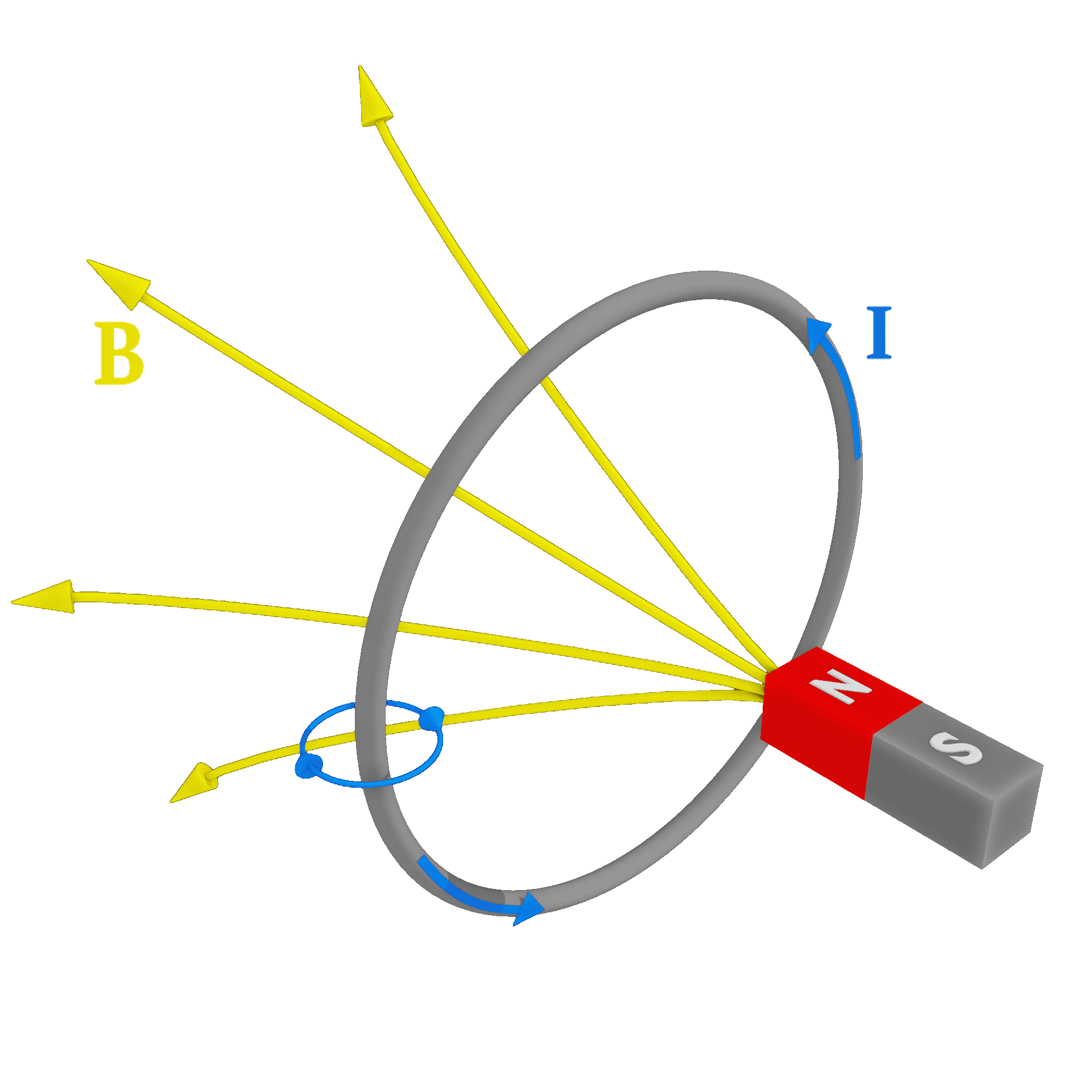
is the magnetic field from the magnet
The current () flows counter-clockwise through the wire, and the current's magnetic field flows clockwise.
For a magnet with its south pole facing the wire:
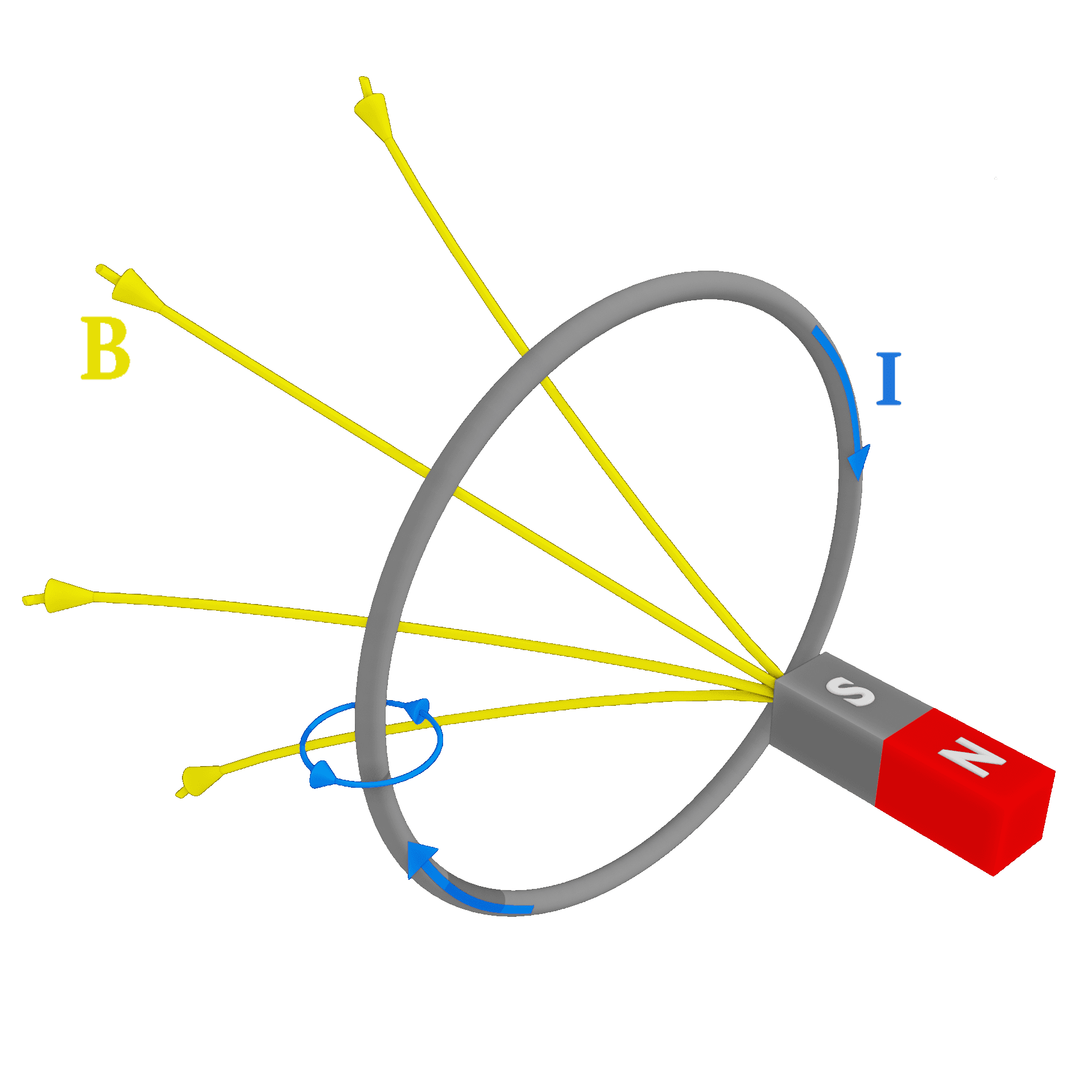
Lenz's Law in Action
The eddy currents that slow down magnets as they get closer can be very cool to watch. Here's a great demonstration by electroBOOM on YouTube:
This video shows how when there is less conductor surface area, there is less induced current, and therefore less of a resistive force.
Conclusion
Lenz's Law may seem complex at first, but by using tools like the right-hand rule, it can be broken down into clear, manageable steps. Understanding how and why induced currents oppose changes in magnetic flux makes the law far more intuitive.
Lenz's Law allows us to determine the direction of the induced current in a conductor when a magnet moves nearby, and it provides deeper insight into how Faraday's Law of electromagnetic induction works in practice. Together, these laws explain both the magnitude and direction of induced electrical effects.
When solving problems involving Lenz's Law, Faraday's Law, or any of the fundamental laws of electronics, you can use my collection of interactive electronics tools to verify your results and build confidence in your circuit analysis. If you want to learn about other fundamental laws of circuits, check out my article "Why Electronic Circuits Work the Way They Do".
People Also Ask
About the Author
This article was written by Boden Bensema, an electronics hobbyist focused on teaching beginner-friendly circuit design, breadboarding, and electronics fundamentals.
About page